Engineered once, deployable many times.
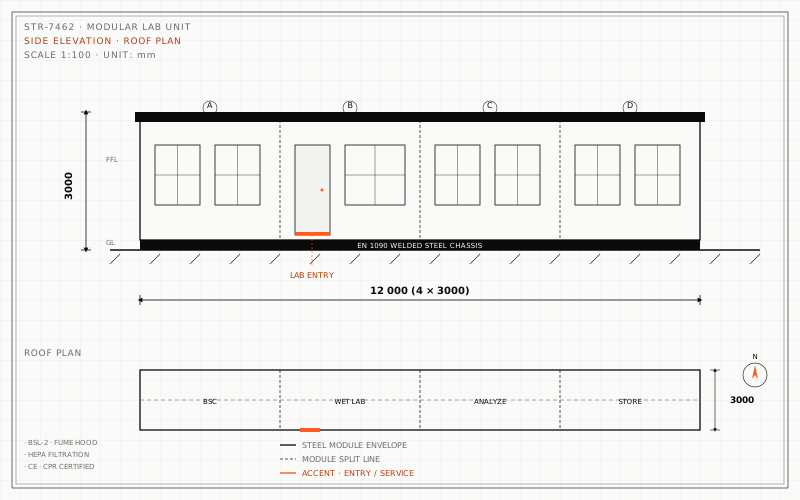
A modular laboratory unit is a permanent laboratory facility built from prefabricated modules with the laboratory benches, fume cupboards, biological safety cabinets, autoclaves, equipment infrastructure and biocontainment features required for modern laboratory science. structmod modular laboratory units serve clinical pathology laboratories (hospital and reference labs), research laboratories (university and institutional research, contract research organisations), industrial quality control laboratories (pharmaceutical, food, environmental), and biocontainment facilities at BSL-2 level (BSL-3 and BSL-4 require additional engineering beyond standard modular configuration).
Standard configurations include modular lab benches (sized to standard 2-, 3-, or 4-bench configurations) with integrated services (gas, vacuum, water, electricity), fume cupboards (compliant with EN 14175), biological safety cabinets (Class II Type A2 or B2 per BSL requirement), autoclave for sterilisation, refrigerated storage for samples and reagents, dedicated zones for sample reception, processing, analysis, and storage, and supporting spaces (administration, gowning, hand-wash). HVAC follows ASHRAE 110 for fume cupboard performance and ISO 14644 cleanroom standards where required. BSL-2 biocontainment includes anteroom for PPE, autoclave for waste sterilisation, and HEPA-filtered exhaust per BSL-2 requirements.
structmod modular laboratory units serve hospital and reference clinical laboratories expanding diagnostic capacity, university and institutional research laboratories establishing new programmes, biotech and pharmaceutical companies establishing new R&D capability, and government laboratories (food safety, environmental monitoring, public health) extending technical capability. Lead time is 12-16 weeks from contract signature for stock configurations, 14-18 weeks for BSL-2 configurations or specialty laboratory configurations. Compliance includes IEC 60364-1 commercial electrical (Group 1 medical for clinical labs), EN 14175 fume cupboards, ISO 14644 cleanroom (where applicable), and ISO 17025 laboratory competence support framework.
Typical deployment sequence
- Day 1 — site foundation verified, screw jacks or strip footings in place
- Day 2–3 — modules lifted into position by mobile crane
- Day 3–4 — inter-module connections and envelope sealing
- Day 4–5 — MEP connections, wet testing
- Day 5–6 — interior finish, fixtures and equipment install
- Day 7 — commissioning, FAT report, user training and handover
Spec sheet — STR-1597
| Overall length | 15.7 m · 51.5 ft |
|---|---|
| Width (transport) | 2.99 m |
| Width (deployed) | 2.99 m |
| Height (transport) | 2.80 m |
| Floor area (deployed) | 46.9 m² |
| Dry weight | 13.7 t |
| Chassis | EN 10025 S355JR hot-rolled steel · EN 1090 EXC-2 |
| Welding quality | EN ISO 3834-3 |
| Envelope | Sandwich panel, PIR core 80 mm · λ ≈ 0.023 W/(m·K) |
| Fire resistance | EI-30 · tested to EN 13501-2 |
| Floor | Marine plywood on EPDM · R-10 slip rating |
| Electrical | 400 V / 50 Hz · 3-phase · IEC 60364 compliant |
| HVAC | VRF multi-split · HEPA H13 (medical) |
| Operating range | −25 °C to +50 °C ambient |
| Wind rating | Designed for 140 km/h basic wind (EN 1991-1-4) |
| Seismic design | Per EN 1998-1 (Eurocode 8) · ductility class DCM |
| Transport | ISO 668 footprint · CSC plate eligible (container variants) |
| Setup time | 4 hours · 2-person crew |
Full drawings, calculation notes, DoP, O&M manual and FAT report included with every unit. Specs indicative — configurable to project requirements.