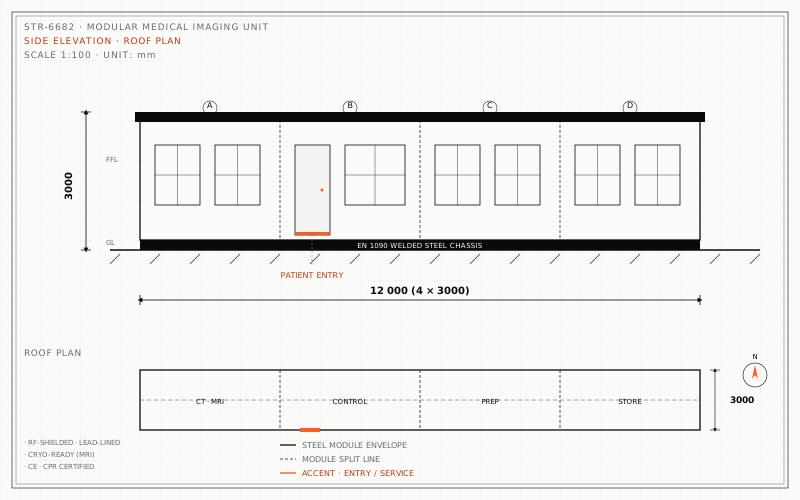
Engineered once, deployable many times.
A modular medical imaging unit is a complete radiology department built from prefabricated modules — multiple imaging modalities, shared reading and reporting infrastructure, integrated patient flow, and clinical support spaces — delivered as a permanent installation in 14-20 weeks turnkey rather than the conventional 18-30 month build. structmod modular medical imaging units serve hospitals expanding diagnostic imaging capacity, replacing legacy radiology departments during major refurbishment, building stand-alone diagnostic centres, or extending into specialty imaging beyond the existing capability.
Standard imaging unit configurations include x-ray rooms (typically 2-4 general radiography rooms with lead shielding), CT room (lead-shielded per NCRP Report 147 with vibration-isolated foundation), MRI suite (full RF cage with 5-gauss line management), 2-3 ultrasound rooms (general and obstetric), fluoroscopy room (where specified), interventional radiology suite (where specified), shared reading room with PACS workstations, technician areas, patient preparation and recovery, and reception/waiting flow. The integrated unit allows efficient staffing, equipment sharing where appropriate, and consolidated patient flow management.
structmod modular medical imaging units deliver to hospitals across European, Gulf and African markets where imaging capacity expansion is a strategic priority, to private diagnostic centre chains opening new locations, and to specialty hospitals integrating advanced imaging capability. Lead time is 14-20 weeks from contract signature for stock configurations, 18-26 weeks for specialty configurations including PET-CT, advanced MRI, or interventional radiology. OEM scanner integration timeline depends on equipment specification and supply chain. Full department commissioning includes radiation safety survey, equipment calibration, PACS/RIS integration testing, and clinical workflow validation.
Typical deployment sequence
- Day 1 — site foundation verified, screw jacks or strip footings in place
- Day 2–3 — modules lifted into position by mobile crane
- Day 3–4 — inter-module connections and envelope sealing
- Day 4–5 — MEP connections, wet testing
- Day 5–6 — interior finish, fixtures and equipment install
- Day 7 — commissioning, FAT report, user training and handover
Spec sheet — STR-2790
| Overall length | 15.0 m · 49.2 ft |
|---|---|
| Width (transport) | 2.99 m |
| Width (deployed) | 2.99 m |
| Height (transport) | 2.70 m |
| Floor area (deployed) | 44.9 m² |
| Dry weight | 9.0 t |
| Chassis | EN 10025 S355JR hot-rolled steel · EN 1090 EXC-2 |
| Welding quality | EN ISO 3834-3 |
| Envelope | Sandwich panel, PIR core 80 mm · λ ≈ 0.023 W/(m·K) |
| Fire resistance | EI-30 · tested to EN 13501-2 |
| Floor | Marine plywood on EPDM · R-10 slip rating |
| Electrical | 230 V / 50 Hz · TN-S · IEC 60364 compliant |
| HVAC | Split inverter heat pump · MERV-8 |
| Operating range | −25 °C to +50 °C ambient |
| Wind rating | Designed for 130 km/h basic wind (EN 1991-1-4) |
| Seismic design | Per EN 1998-1 (Eurocode 8) · ductility class DCM |
| Transport | ISO 668 footprint · CSC plate eligible (container variants) |
| Setup time | 2 hours · 2-person crew |
Full drawings, calculation notes, DoP, O&M manual and FAT report included with every unit. Specs indicative — configurable to project requirements.