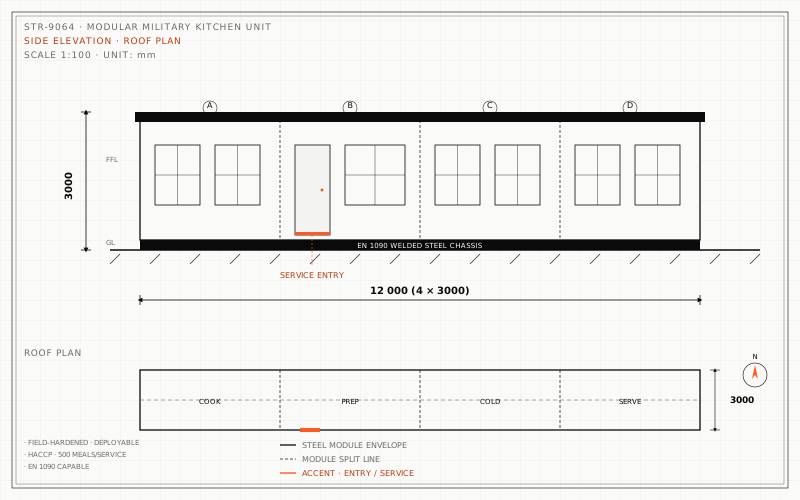
Engineered once, deployable many times.
A modular military kitchen unit is a battalion-scale catering facility built from prefabricated modules with the cold storage, dry storage, food preparation, cooking line, plating workflow and cleaning infrastructure required to feed deployed military forces. structmod modular military kitchens produce 1,500-3,000 rations per service cycle (breakfast, lunch, dinner) for battalion or brigade-sized formations. The modular construction approach delivers a fully-equipped catering facility in 10-12 weeks turnkey, then redeploys with the formation as operational requirements change.
Standard configurations organise the kitchen around the food production workflow: cold storage modules (walk-in chillers and freezers sized to multi-day food stocks), dry storage with ration accountability infrastructure, food preparation zones (vegetable prep, meat prep, baking prep — each separated for HACCP compliance), cooking line with combi ovens, bratt pans, fryers and tilting kettles sized to ration count, plating and serving zone, return cleaning workflow with dishwashers and sanitation, and a small mess area for kitchen staff dining. Centralised mechanical room houses gas supply, water heating, ventilation extract and refrigeration plant. Catering equipment is military-spec rugged with simplified maintenance and consumables sourced through standard military supply chains.
structmod modular military kitchens serve deployed forces requiring battalion-level catering — peacekeeping operations, training exercises in remote locations, expeditionary deployments without host nation catering, and humanitarian support operations. Lead time is 10-12 weeks from contract signature. Catering equipment selection (which OEMs, what gas vs electric balance, what portion sizes) is specified against the deploying force's catering doctrine and consumables supply chain. HACCP food safety design follows ISO 22000 principles; ventilation and grease management follow NFPA 96 (or destination-country fire code equivalent).
Typical deployment sequence
- Day 1 — site foundation verified, screw jacks or strip footings in place
- Day 2–3 — modules lifted into position by mobile crane
- Day 3–4 — inter-module connections and envelope sealing
- Day 4–5 — MEP connections, wet testing
- Day 5–6 — interior finish, fixtures and equipment install
- Day 7 — commissioning, FAT report, user training and handover
Spec sheet — STR-2956
| Overall length | 15.6 m · 51.2 ft |
|---|---|
| Width (transport) | 2.99 m |
| Width (deployed) | 2.99 m |
| Height (transport) | 3.10 m |
| Floor area (deployed) | 46.6 m² |
| Dry weight | 13.6 t |
| Chassis | EN 10025 S355JR hot-rolled steel · EN 1090 EXC-2 |
| Welding quality | EN ISO 3834-3 |
| Envelope | Sandwich panel, PIR core 80 mm · λ ≈ 0.023 W/(m·K) |
| Fire resistance | EI-30 · tested to EN 13501-2 |
| Floor | Marine plywood on EPDM · R-10 slip rating |
| Electrical | 400 V / 50 Hz · 3-phase · IEC 60364 compliant |
| HVAC | VRF multi-split · HEPA H13 (medical) |
| Operating range | −25 °C to +50 °C ambient |
| Wind rating | Designed for 140 km/h basic wind (EN 1991-1-4) |
| Seismic design | Per EN 1998-1 (Eurocode 8) · ductility class DCM |
| Transport | ISO 668 footprint · CSC plate eligible (container variants) |
| Setup time | 3 hours · 2-person crew |
Full drawings, calculation notes, DoP, O&M manual and FAT report included with every unit. Specs indicative — configurable to project requirements.