Engineered once, deployable many times.
A modular military surgery unit is a forward-deployed surgical facility built from prefabricated modules with the operating theatre, anaesthesia, scrub bay, recovery and patient holding capability required for damage-control surgery in expeditionary military operations. structmod modular military surgery units provide NATO Role 2 forward surgical capability — sized to stabilise battlefield casualties before evacuation to higher-echelon care, with the rugged engineering and infection-control performance that field surgery demands. The modular construction approach allows the surgical unit to deploy with the supported formation, then redeploy as the operational picture changes.
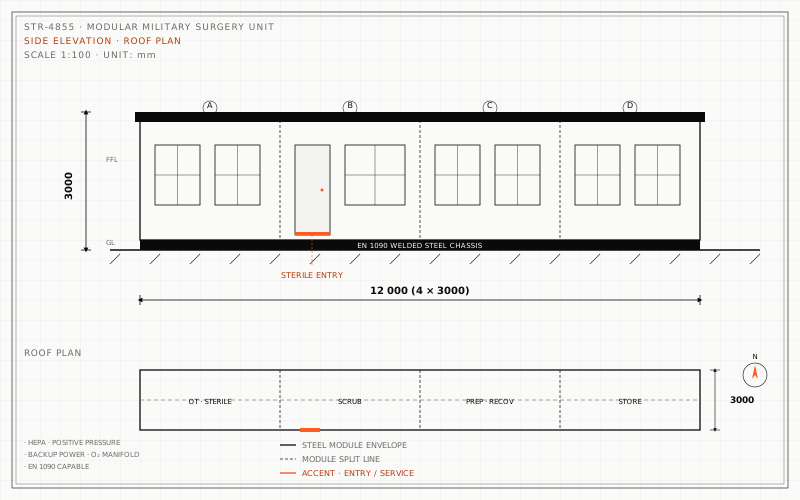
Standard configurations include the operating theatre (UK HBN 26-01 equivalent or ISO 14644 class 7 ultra-clean ventilation), anaesthesia workstation with gas scavenging, scrub sink bay at the theatre entrance, clean preparation zone, dirty instrument return, 4-6 bed recovery and patient holding ward, and supporting clinical spaces (medication preparation, sterile stock, biomedical engineering bench). Medical gas reticulation per ISO 9170 with cylinder-bank backup; medical electrical per IEC 60364-7-710 Group 2 with isolated power and UPS; environmental control per CBRN-protective configuration where threat assessment requires. Operating theatre environment is validated through microbiological commissioning before clinical use.
structmod modular military surgery units serve forward surgical teams (FST), shock trauma platoons, expeditionary medical units, and battalion aid stations operating beyond Role 1 capability. NATO STANAG 2560 medical evaluation criteria, AMedP-9.1 modular medical support principles, and STANAG 2345 MEDEVAC interface compatibility guide the design. Lead time is 12-14 weeks from contract signature for stock configurations, 14-18 weeks for configurations with extended holding, ICU integration or ballistic envelope. Clinical commissioning includes microbiological air sampling, equipment calibration and surgical workflow validation per the deploying service's clinical protocols.
Typical deployment sequence
- Day 1 — site foundation verified, screw jacks or strip footings in place
- Day 2–3 — modules lifted into position by mobile crane
- Day 3–4 — inter-module connections and envelope sealing
- Day 4–5 — MEP connections, wet testing
- Day 5–6 — interior finish, fixtures and equipment install
- Day 7 — commissioning, FAT report, user training and handover
Spec sheet — STR-2999
| Overall length | 15.9 m · 52.2 ft |
|---|---|
| Width (transport) | 2.99 m |
| Width (deployed) | 2.99 m |
| Height (transport) | 3.20 m |
| Floor area (deployed) | 47.5 m² |
| Dry weight | 11.9 t |
| Chassis | EN 10025 S355JR hot-rolled steel · EN 1090 EXC-2 |
| Welding quality | EN ISO 3834-3 |
| Envelope | Sandwich panel, PIR core 80 mm · λ ≈ 0.023 W/(m·K) |
| Fire resistance | EI-30 · tested to EN 13501-2 |
| Floor | Marine plywood on EPDM · R-10 slip rating |
| Electrical | 120/240 V · 60 Hz (US-spec) · IEC 60364 compliant |
| HVAC | Packaged rooftop · MERV-13 |
| Operating range | −25 °C to +50 °C ambient |
| Wind rating | Designed for 150 km/h basic wind (EN 1991-1-4) |
| Seismic design | Per EN 1998-1 (Eurocode 8) · ductility class DCM |
| Transport | ISO 668 footprint · CSC plate eligible (container variants) |
| Setup time | 2–7 days on site |
Full drawings, calculation notes, DoP, O&M manual and FAT report included with every unit. Specs indicative — configurable to project requirements.