Engineered once, deployable many times.
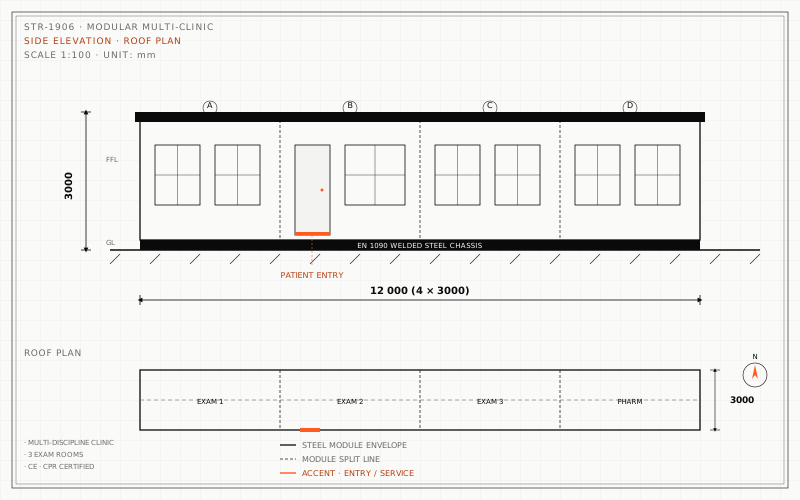
A modular multi-clinic is a permanent multi-specialty outpatient clinic — combining primary care, specialty consultation rooms, diagnostic services and supporting clinical infrastructure in a single integrated facility. structmod modular multi-clinics serve as community polyclinics, district health centres or specialty consultation hubs — delivering broad clinical capability close to the patient population without the cost and complexity of a full hospital build. The modular construction approach delivers a 6-12 specialty multi-clinic in 12-16 weeks turnkey, compared to 12-24 months for conventional polyclinic construction.
Standard configurations organise the clinic around a shared central core (reception, waiting, records, pharmacy, basic diagnostics) with specialty consultation wings radiating outward. Typical specialty mix includes general practice (4-8 examination rooms), women's health (gynaecology, antenatal, family planning), paediatric (well-child, immunisation, sick child), dental (2-4 chairs), ophthalmology (examination, refraction, minor procedures), ENT (consultation, audiology), dermatology (consultation, minor procedures), mental health (consultation, counselling), and physiotherapy (treatment area, exercise space). Diagnostic services include x-ray, ultrasound, ECG, point-of-care laboratory, and pharmacy dispensing.
structmod modular multi-clinics deliver to national health ministries building community health infrastructure (the WHO Astana Declaration's primary healthcare model), to district hospital networks extending outpatient capacity to underserved areas, to private healthcare chains opening community polyclinics, and to large employers providing comprehensive workforce healthcare. Lead time is 12-16 weeks from contract signature for stock 6-specialty configurations, 14-18 weeks for larger or customised configurations. Compliance covers IEC 60364-7-710 medical electrical, infection control per national standard, and ministry-of-health departmental requirements per destination country.
Typical deployment sequence
- Day 1 — site foundation verified, screw jacks or strip footings in place
- Day 2–3 — modules lifted into position by mobile crane
- Day 3–4 — inter-module connections and envelope sealing
- Day 4–5 — MEP connections, wet testing
- Day 5–6 — interior finish, fixtures and equipment install
- Day 7 — commissioning, FAT report, user training and handover
Spec sheet — STR-2027
| Overall length | 14.7 m · 48.2 ft |
|---|---|
| Width (transport) | 2.99 m |
| Width (deployed) | 2.99 m |
| Height (transport) | 3.20 m |
| Floor area (deployed) | 44.0 m² |
| Dry weight | 11.7 t |
| Chassis | EN 10025 S355JR hot-rolled steel · EN 1090 EXC-2 |
| Welding quality | EN ISO 3834-3 |
| Envelope | Sandwich panel, PIR core 80 mm · λ ≈ 0.023 W/(m·K) |
| Fire resistance | EI-30 · tested to EN 13501-2 |
| Floor | Marine plywood on EPDM · R-10 slip rating |
| Electrical | 120/240 V · 60 Hz (US-spec) · IEC 60364 compliant |
| HVAC | Packaged rooftop · MERV-13 |
| Operating range | −25 °C to +50 °C ambient |
| Wind rating | Designed for 150 km/h basic wind (EN 1991-1-4) |
| Seismic design | Per EN 1998-1 (Eurocode 8) · ductility class DCM |
| Transport | ISO 668 footprint · CSC plate eligible (container variants) |
| Setup time | 4 hours · 2-person crew |
Full drawings, calculation notes, DoP, O&M manual and FAT report included with every unit. Specs indicative — configurable to project requirements.