Engineered once, deployable many times.
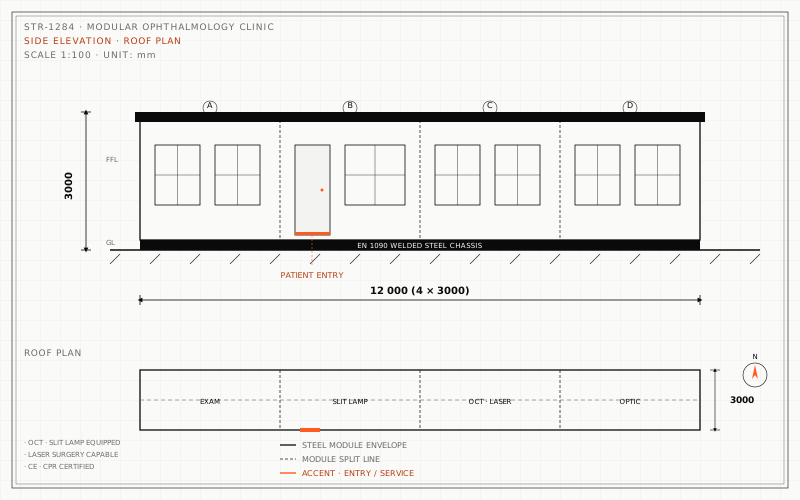
A modular ophthalmology clinic is a permanent eye care facility built from prefabricated modules with the examination lanes, laser treatment rooms, ophthalmic operating theatre, recovery and pharmacy infrastructure already integrated. structmod modular ophthalmology clinics serve specialty eye hospitals scaling cataract surgery capacity, regional eye care programmes building dedicated infrastructure, university teaching eye hospitals, and humanitarian eye care programmes (Orbis, Sightsavers, CBM-supported) establishing semi-permanent presence. The 12-16 week turnkey delivery accelerates clinical opening compared to 12-24 month conventional builds.
Standard configurations organise the eye clinic around the patient pathway: arrival and visual acuity assessment in the entry zone; examination lanes (typically 4-8) for refraction, slit-lamp biomicroscopy, fundus examination and supplementary testing (OCT, visual fields, corneal topography); diagnostic imaging room (fundus camera, fluorescein angiography); laser treatment rooms for retinal photocoagulation, YAG capsulotomy and SLT glaucoma treatment; ophthalmic operating theatre with operating microscope, phacoemulsification capability, vitrectomy capability where specified; recovery bay with monitored seats; and supporting clinical and administrative infrastructure including dedicated ophthalmic pharmacy.
structmod modular ophthalmology clinics deliver to national cataract programmes (clearing surgical waiting lists in countries with significant cataract blindness burden), to private eye hospital chains opening new locations, to international NGOs running eye care programmes, and to academic ophthalmology departments establishing teaching infrastructure. Lead time is 12-16 weeks from contract signature for stock configurations, 16-20 weeks for full eye hospital configurations including vitrectomy and corneal surgery capability. Compliance includes IEC 60364-7-710 medical electrical, ophthalmic device regulation per destination country, and infection control per national surgical standards.
Typical deployment sequence
- Day 1 — site foundation verified, screw jacks or strip footings in place
- Day 2–3 — modules lifted into position by mobile crane
- Day 3–4 — inter-module connections and envelope sealing
- Day 4–5 — MEP connections, wet testing
- Day 5–6 — interior finish, fixtures and equipment install
- Day 7 — commissioning, FAT report, user training and handover
Spec sheet — STR-4727
| Overall length | 12.7 m · 41.7 ft |
|---|---|
| Width (transport) | 2.99 m |
| Width (deployed) | 2.99 m |
| Height (transport) | 3.20 m |
| Floor area (deployed) | 38.0 m² |
| Dry weight | 11.7 t |
| Chassis | EN 10025 S355JR hot-rolled steel · EN 1090 EXC-2 |
| Welding quality | EN ISO 3834-3 |
| Envelope | Sandwich panel, PIR core 80 mm · λ ≈ 0.023 W/(m·K) |
| Fire resistance | EI-30 · tested to EN 13501-2 |
| Floor | Marine plywood on EPDM · R-10 slip rating |
| Electrical | 120/240 V · 60 Hz (US-spec) · IEC 60364 compliant |
| HVAC | Packaged rooftop · MERV-13 |
| Operating range | −25 °C to +50 °C ambient |
| Wind rating | Designed for 150 km/h basic wind (EN 1991-1-4) |
| Seismic design | Per EN 1998-1 (Eurocode 8) · ductility class DCM |
| Transport | ISO 668 footprint · CSC plate eligible (container variants) |
| Setup time | 4 hours · 2-person crew |
Full drawings, calculation notes, DoP, O&M manual and FAT report included with every unit. Specs indicative — configurable to project requirements.