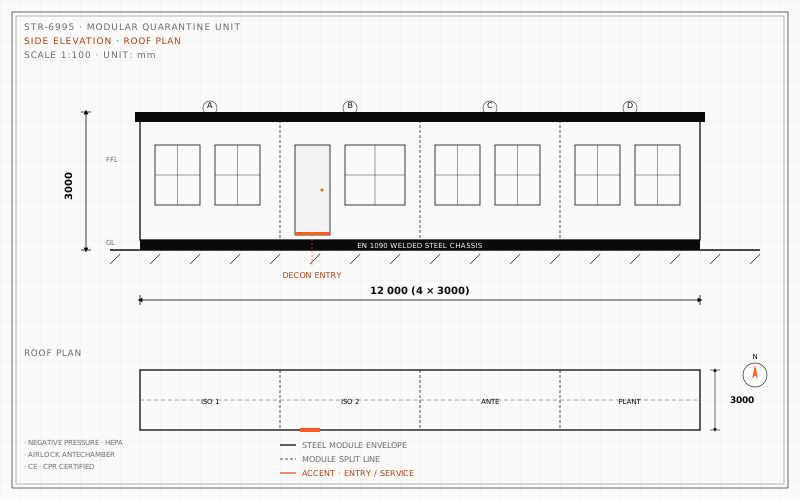
Engineered once, deployable many times.
A modular quarantine unit is a permanent biocontainment facility built from prefabricated modules with the negative-pressure isolation rooms, anteroom airlocks, HEPA-filtered exhaust, infection-control workflow and safe patient/staff flow already integrated. structmod modular quarantine units serve hospitals building dedicated infectious disease capability (in response to COVID-19 lessons learned), public health programmes establishing pandemic-ready infrastructure, port and border health authorities running quarantine for international travellers, and humanitarian programmes responding to outbreaks (Ebola, Marburg, novel respiratory viruses). The 12-16 week turnkey delivery is critical for outbreak response when conventional construction cannot match the timeline.
The infection control architecture is the defining engineering feature. Each isolation room operates at -10 Pa to -25 Pa relative to the corridor, with HEPA H13 filtration on the exhaust stream and discharge above building roofline to prevent re-entrainment. Anteroom airlocks between corridor and isolation room buffer the pressure transition and provide PPE donning/doffing space; airflow direction is corridor → anteroom → isolation room → HEPA exhaust, never reversed. Pressure monitoring with audible and visual alarms alerts staff to any pressure deviation. Single-patient configurations with private bathrooms suit individual quarantine; small-cohort configurations (4-6 beds with shared facilities) suit suspected-case observation pending diagnostic confirmation.
structmod modular quarantine units deliver to national public health programmes building outbreak-ready infrastructure (the lesson from COVID-19 was the inadequacy of conventional hospital infection control for novel respiratory pathogens), to hospitals upgrading existing infectious disease capability, to international travel hubs (airports, seaports, border crossings) implementing public health surveillance, and to research institutions running clinical trials for biocontainment-required pathogens. Lead time is 12-16 weeks from contract signature for standard configurations. Compliance includes WHO Infection Prevention and Control standards, ASHRAE 170 ventilation for healthcare facilities, and CDC Isolation Precautions guidance.
Typical deployment sequence
- Day 1 — site foundation verified, screw jacks or strip footings in place
- Day 2–3 — modules lifted into position by mobile crane
- Day 3–4 — inter-module connections and envelope sealing
- Day 4–5 — MEP connections, wet testing
- Day 5–6 — interior finish, fixtures and equipment install
- Day 7 — commissioning, FAT report, user training and handover
Spec sheet — STR-2374
| Overall length | 13.4 m · 44.0 ft |
|---|---|
| Width (transport) | 2.99 m |
| Width (deployed) | 2.99 m |
| Height (transport) | 3.10 m |
| Floor area (deployed) | 40.1 m² |
| Dry weight | 16.4 t |
| Chassis | EN 10025 S355JR hot-rolled steel · EN 1090 EXC-2 |
| Welding quality | EN ISO 3834-3 |
| Envelope | Sandwich panel, PIR core 80 mm · λ ≈ 0.023 W/(m·K) |
| Fire resistance | EI-30 · tested to EN 13501-2 |
| Floor | Marine plywood on EPDM · R-10 slip rating |
| Electrical | 400 V / 50 Hz · 3-phase · IEC 60364 compliant |
| HVAC | VRF multi-split · HEPA H13 (medical) |
| Operating range | −25 °C to +50 °C ambient |
| Wind rating | Designed for 140 km/h basic wind (EN 1991-1-4) |
| Seismic design | Per EN 1998-1 (Eurocode 8) · ductility class DCM |
| Transport | ISO 668 footprint · CSC plate eligible (container variants) |
| Setup time | 2–7 days on site |
Full drawings, calculation notes, DoP, O&M manual and FAT report included with every unit. Specs indicative — configurable to project requirements.