Engineered once, deployable many times.
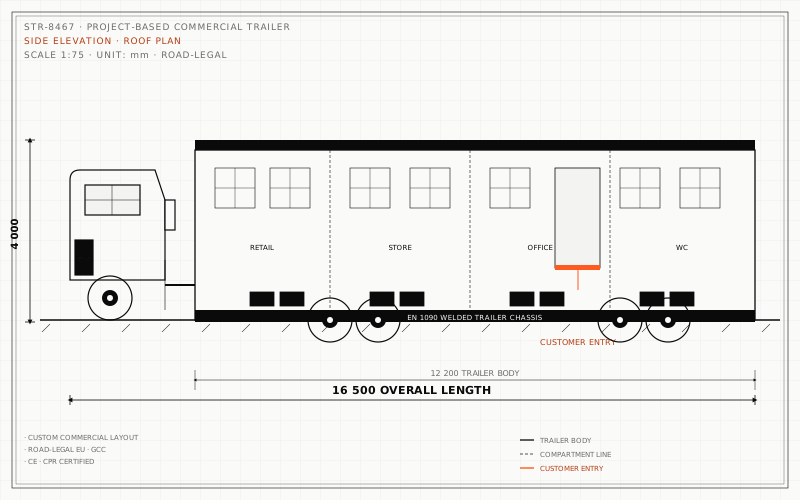
A project-based commercial trailer is a custom-engineered mobile commercial facility designed around a specific business case — industry sector, operational workflow, equipment integration, and regulatory environment — rather than drawn from a catalogue. structmod design-build delivery for commercial trailers begins with the operating organisation's business brief (target operation, revenue model, equipment list, regulatory environment) and ends with a commissioned mobile unit ready for commercial use. Custom commercial trailers serve businesses where catalogue products don't match the specific need — retail pop-up operations, specialty business concepts, technology demonstration units, mobile research and development platforms, and industry-specific operational units.
Typical custom project briefs include: retail pop-up concepts (specialty retail, food service, beverage brands extending brand presence mobilely), specialty business operations (mobile specialty shops, artisan craft demonstrations, boutique services), technology demonstration units (product showcase trailers for industrial or commercial products), mobile research and development platforms (product testing, focus group facilities, user research environments), and industry-specific operational units (agricultural equipment, marine services, specialty construction services). Design begins with a business workshop where structmod engineering, the operating business team, and any specialist consultants work through requirements before detail engineering begins.
structmod project-based commercial trailers serve operators across commercial niches — retail brands running pop-up programmes to test new markets, specialty businesses building mobile concepts as business expansion, technology companies running demonstration programmes supporting sales campaigns, market research and user experience organisations conducting field research, and specialty service providers offering mobile capability to their customers. Lead time is 14-18 weeks from contract signature for typical custom projects, longer for complex configurations with extensive equipment integration. Compliance includes destination-country commercial operation regulation, IEC 60364-1 commercial electrical, DOT/E-mark vehicle homologation, and any industry-specific regulatory framework.
Typical deployment sequence
- Hour 0 — trailer arrives on tow vehicle, positioned and chocked
- Hour 0–1 — stabilizer jacks deployed, leveling verified
- Hour 1–2 — hydraulic walls or slide-outs extended where fitted
- Hour 2–3 — utility connections (power, water, wastewater)
- Hour 3–4 — functional test per FAT protocol
- Hour 4 — operational handover with user training
Spec sheet — STR-3212
| Overall length | 13.2 m · 43.3 ft |
|---|---|
| Width (transport) | 2.55 m |
| Width (deployed) | 5.00 m |
| Height (transport) | 2.90 m |
| Floor area (deployed) | 66.0 m² |
| Dry weight | 17.2 t |
| Chassis | EN 10025 S355JR hot-rolled steel · EN 1090 EXC-2 |
| Welding quality | EN ISO 3834-3 |
| Envelope | Sandwich panel, PIR core 80 mm · λ ≈ 0.023 W/(m·K) |
| Fire resistance | EI-30 · tested to EN 13501-2 |
| Floor | Marine plywood on EPDM · R-10 slip rating |
| Electrical | 120/240 V · 60 Hz (US-spec) · IEC 60364 compliant |
| HVAC | Packaged rooftop · MERV-13 |
| Operating range | −25 °C to +50 °C ambient |
| Wind rating | Designed for 150 km/h basic wind (EN 1991-1-4) |
| Transport | ISO 668 footprint · CSC plate eligible (container variants) |
| Setup time | 4 hours · 2-person crew |
Full drawings, calculation notes, DoP, O&M manual and FAT report included with every unit. Specs indicative — configurable to project requirements.