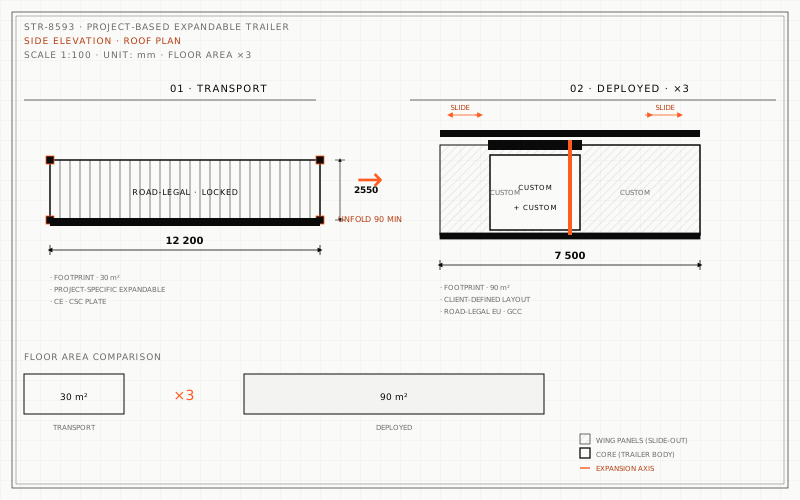
Engineered once, deployable many times.
A project-based expandable trailer is a custom-engineered pop-out trailer designed around a specific operational need — hydraulic pop-out configuration, specialised interior fit-out, equipment integration, and regulatory environment — rather than drawn from a catalogue. structmod design-build delivery for expandable trailers begins with the operating organisation's brief (target operation, deployed footprint requirement, interior functional needs, equipment list, regulatory framework) and ends with a commissioned expandable unit ready for operational use. Custom expandable trailers serve operations where catalogue expandable products don't match the specific need — specialty clinical configurations beyond standard medical trailers, specialty laboratory or research configurations, specialty command and control configurations, and unique operational requirements.
Typical custom expandable project briefs include: specialty clinical trailers (specific single-disease clinics, rare specialty consultation, bespoke research site trailers), specialty laboratory configurations (unique equipment integration, specific clean room requirements, specialty BSL or high-containment work), specialty command and control configurations (specific communications architecture, unique intelligence integration, national doctrine-specific workflow), and unique operational requirements (specialty broadcasting, specialty entertainment production, bespoke industrial applications). Design begins with an operational workshop where requirements work through before detail engineering.
structmod project-based expandable trailers serve operators across specialty niches — specialty medical programmes requiring bespoke clinical configuration, research organisations running specialty field campaigns, defence forces requiring mission-specific expandable capability, and specialty industrial operators requiring expandable working environments. Lead time is 16-22 weeks from contract signature for typical custom projects — longer than catalogue due to expandable engineering complexity. Hydraulic deployment per Machinery Directive 2006/42/EC, EN 1090 EXC-2 chassis, IEC 60364-1 commercial or IEC 60364-7-710 medical electrical per application, and any operation-specific regulatory framework.
Typical deployment sequence
- Hour 0 — trailer arrives on tow vehicle, positioned and chocked
- Hour 0–1 — stabilizer jacks deployed, leveling verified
- Hour 1–2 — hydraulic walls or slide-outs extended where fitted
- Hour 2–3 — utility connections (power, water, wastewater)
- Hour 3–4 — functional test per FAT protocol
- Hour 4 — operational handover with user training
Spec sheet — STR-3204
| Overall length | 12.4 m · 40.7 ft |
|---|---|
| Width (transport) | 2.55 m |
| Width (deployed) | 5.00 m |
| Height (transport) | 2.70 m |
| Floor area (deployed) | 62.0 m² |
| Dry weight | 9.4 t |
| Chassis | EN 10025 S355JR hot-rolled steel · EN 1090 EXC-2 |
| Welding quality | EN ISO 3834-3 |
| Envelope | Sandwich panel, PIR core 80 mm · λ ≈ 0.023 W/(m·K) |
| Fire resistance | EI-30 · tested to EN 13501-2 |
| Floor | Marine plywood on EPDM · R-10 slip rating |
| Electrical | 230 V / 50 Hz · TN-S · IEC 60364 compliant |
| HVAC | Split inverter heat pump · MERV-8 |
| Operating range | −25 °C to +50 °C ambient |
| Wind rating | Designed for 130 km/h basic wind (EN 1991-1-4) |
| Transport | ISO 668 footprint · CSC plate eligible (container variants) |
| Setup time | 2–4 hours · 2-person crew |
Full drawings, calculation notes, DoP, O&M manual and FAT report included with every unit. Specs indicative — configurable to project requirements.