Engineered once, deployable many times.
A project-based military modular solution is a custom-engineered modular facility or complex designed around a specific defense mission — forward operating base, training establishment, clinical capability, command and control centre, or specialised capability such as CBRN response or special operations support. structmod design-build for defense integrates all disciplines — architecture, structural, MEP, security engineering, communications, CBRN, ballistic protection where specified — into a single coordinated solution that addresses the operational mission rather than just providing a building.
Typical defense modular solutions include barracks and accommodation for 50-5,000 personnel with full life-support infrastructure (mess, ablutions, laundry, medical, recreation), headquarters buildings with classified-communications-ready operations rooms, clinical facilities from battalion aid stations through Role 2+ field hospitals to fixed-base garrison health centres, specialised capabilities (vehicle maintenance, weapons storage, simulator facilities, CBRN response centres), and training establishments (classrooms, simulators, accommodation for instructional cadres). Each solution is engineered to the client's operational doctrine and national defense standards.
structmod is NATO CAGE registered and works with NATO member defense ministries, allied nations' armed forces, UN peacekeeping procurement chains, and defense prime contractors. Project documentation includes compliance matrices against STANAG and AMedP references (STANAG 2345 MEDEVAC, STANAG 2560 medical evaluation, STANAG 4447 CBRN, AMedP-9.1 modular medical), national defense engineering standards, and security classification handling from unclassified through restricted. Delivery integrates with defense logistics chains — modules can be packed to MIL-STD transport specifications and deployed by military airlift, sea lift or ground transport.
Typical deployment sequence
- Month 1 — site preparation, foundation works, utilities trenching
- Month 2–3 — primary steel structure erection (EN 1090)
- Month 3–5 — envelope closure, roofing, curtain wall
- Month 5–7 — MEP rough-in, medical gas, emergency power
- Month 7–10 — interior fit-out, equipment installation
- Month 10–12 — commissioning, FAT/SAT, user training
- Month 12 — clinical handover with full O&M dossier
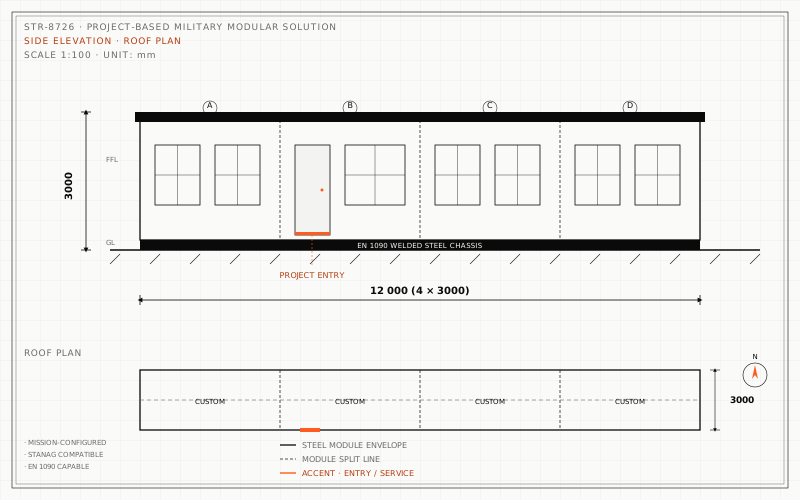
Spec sheet — STR-3974
| Overall length | 13.4 m · 44.0 ft |
|---|---|
| Width (transport) | 2.99 m |
| Width (deployed) | 2.99 m |
| Height (transport) | 2.90 m |
| Floor area (deployed) | 40.1 m² |
| Dry weight | 14.4 t |
| Chassis | EN 10025 S355JR hot-rolled steel · EN 1090 |
| Welding quality | EN ISO 3834-2 · certified RWC (IWE) |
| Envelope | Sandwich panel, PIR core 80 mm · λ ≈ 0.023 W/(m·K) |
| Fire resistance | EI-30 · tested to EN 13501-2 |
| Floor | Marine plywood on EPDM · R-10 slip rating |
| Electrical | 120/240 V · 60 Hz (US-spec) · IEC 60364 compliant |
| HVAC | Packaged rooftop · MERV-13 |
| Operating range | −25 °C to +50 °C ambient |
| Wind rating | Designed for 150 km/h basic wind (EN 1991-1-4) |
| Seismic design | Per EN 1998-1 (Eurocode 8) · ductility class DCM |
| Transport | ISO 668 footprint · CSC plate eligible (container variants) |
| Setup time | 4–16 weeks on site |
Full drawings, calculation notes, DoP, O&M manual and FAT report included with every unit. Specs indicative — configurable to project requirements.