Engineered once, deployable many times.
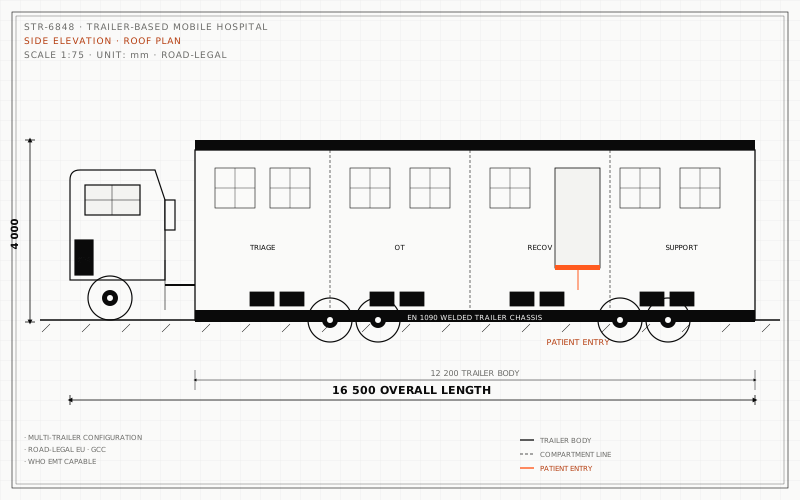
A trailer-based mobile hospital is a hospital campus assembled from road-legal trailer modules that couple on site through shared corridors to form an integrated clinical facility. structmod trailer-based mobile hospitals leverage the transport advantages of the trailer platform — road deployment anywhere roads can reach, self-levelling hydraulics, 2-6 hour individual unit setup — combined with the clinical depth of a fully integrated hospital: surgical theatres, intensive care, wards, imaging, laboratory and pharmacy.
Each trailer module in the mobile hospital is a complete clinical function: a surgical trailer houses one or two operating theatres with anaesthesia, scrub and recovery; an ICU trailer houses 4-6 beds with full monitoring; a ward trailer accommodates 12-16 beds; an imaging trailer carries X-ray, ultrasound or CT. Modules couple through airtight vestibules that maintain clinical climate and infection control across the entire campus — supporting proper clinical workflow, cleanliness zones and patient movement between specialties.
structmod trailer-based mobile hospitals deploy for healthcare access programmes, hospital renovation bridging, epidemic surge response, humanitarian missions and military forward medical capability. The trailer platform excels where road transport is available, frequent redeployment is expected, or clinical operations must continue during hospital construction. Lead time is 8-16 weeks from contract signature for 50-bed base configurations. Expansion to 100, 150 or 200+ bed capacity is achieved by adding ward, surgical and support trailers without replacing existing modules.
Typical deployment sequence
- Hour 0–2 — trailer or container units arrive on site
- Hour 2–6 — positioning, leveling and inter-unit connection
- Hour 6–12 — envelope sealing, MEP hook-up, medical gas
- Hour 12–24 — equipment install, commissioning, FAT
- Hour 24–72 — user training, operational handover
Spec sheet — STR-2901
| Overall length | 14.1 m · 46.3 ft |
|---|---|
| Width (transport) | 2.99 m |
| Width (deployed) | 2.99 m |
| Height (transport) | 3.00 m |
| Floor area (deployed) | 42.2 m² |
| Dry weight | 12.1 t |
| Chassis | EN 10025 S355JR hot-rolled steel · EN 1090 EXC-3 |
| Welding quality | EN ISO 3834-2 · certified RWC (IWE) |
| Envelope | Sandwich panel, PIR core 80 mm · λ ≈ 0.023 W/(m·K) |
| Fire resistance | EI-30 · tested to EN 13501-2 |
| Floor | Marine plywood on EPDM · R-10 slip rating |
| Electrical | 230 V / 50 Hz · TN-S · IEC 60364 compliant |
| HVAC | Split inverter heat pump · MERV-8 |
| Operating range | −25 °C to +50 °C ambient |
| Wind rating | Designed for 130 km/h basic wind (EN 1991-1-4) |
| Seismic design | Per EN 1998-1 (Eurocode 8) · ductility class DCM |
| Transport | ISO 668 footprint · CSC plate eligible (container variants) |
| Setup time | 24–72 hours · 4–6-person crew |
Full drawings, calculation notes, DoP, O&M manual and FAT report included with every unit. Specs indicative — configurable to project requirements.